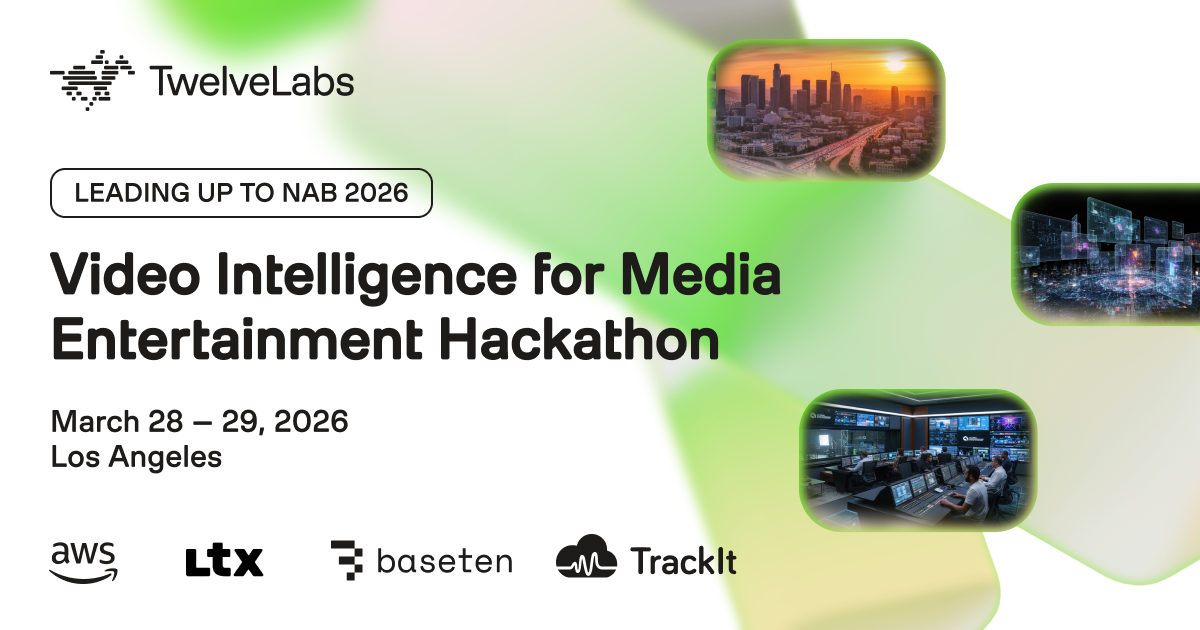
Build the Future of Media Tech Before NAB 2026
Video is 82% of internet traffic and 90% of unstructured enterprise data. Yet most systems managing this data treat video like it's just a series of images. They sample frames, run object detection, and call it done.
That's why studios spend $75K-150K per editor annually on manual search labor. Why compliance review runs at 1:1 ratio (one hour of watching per hour of content). Why editors spend 4-8 hours scrubbing footage to find a single moment.
This hackathon asks you to close that gap.
What You're Building
Choose one of three challenge tracks, each addressing a real production bottleneck with quantifiable costs:
🔍 Archive Intelligence Build semantic search that makes petabyte-scale libraries actually queryable. Most studios can't find 80%+ of the footage they own. Your solution should let producers search in natural language ("sunset over water with birds flying") and get timestamped results in seconds instead of hours.
✂️ Intelligent Segmentation Create systems that detect semantic boundaries in long-form video. Think ad breaks that feel natural (not mid-sentence cuts), news story segmentation based on topic changes (not just camera cuts), or structural analysis that understands narrative flow. Manual segmentation costs $50-100 per hour—your solution should make it minutes.
✅ Compliance Guardian Automate content review with explainable AI. Build a system that flags violations ("beer bottle at 3:42 in scene with minors") with enough context for fast human validation. Compliance delays cost days of time-to-market and single violations risk $10K-$10M+ fines. Your solution needs to be both fast and auditable.
Why This Matters
NAB 2026 starts three weeks after this hackathon. While NAB will be full of vendor pitches about the future, this weekend is about actually building infrastructure that works today.
Several past TwelveLabs hackathon projects have turned into production deployments and formal vendor evaluations. The judges sitting in this room represent the buyers and technical decision-makers at tier 1 media companies. What you build here has legs beyond the weekend.
Technology Stack
TwelveLabs Marengo + Pegasus via AWS Bedrock All participants receive AWS Bedrock credits to access TwelveLabs' video foundation models. Marengo handles multimodal embeddings and semantic search. Pegasus generates descriptions and structured outputs. Bedrock provides enterprise infrastructure with built-in governance controls.
Sponsor Platforms (Recommended)
- Baseten: Production model serving and application orchestration
- LTX: Video generation and editing for post-processing workflows
- TrackIt: AWS solutions architecture expertise for media workload optimization
- NVIDIA: GPU-accelerated inference guidance
Prizes & Recognition
Total Prize Pool: $2,250 + Extended API Credits
- 1st Place: $1,000 + API Credits
- 2nd Place: $750 + API Credits
- 3rd Place: $500 + API Credits
More valuable than prizes: Technical validation from practitioners who've shipped these systems in production. Judges include TwelveLabs engineering leadership, AWS solutions architects, studio executives, and sponsor technical teams.
Event Schedule
Saturday, March 28
- 9:00 AM: Registration & Breakfast
- 10:00 AM: Opening Keynote + Challenge Introductions
- 10:45 AM: Team Formation
- 11:00 AM: Hacking Begins (AWS Bedrock credits + API keys distributed)
- 12:00 PM: Lunch Provided
- 1:00-3:30 PM: Technical Workshops (TwelveLabs, AWS, Baseten, LTX, NVIDIA)
- 4:00 PM: Office Hours Begin
- 5:00 PM: Venue Closes (continue remotely or rest)
Sunday, March 29
- 9:00 AM: Venue Opens, Final Sprint
- 9:30 AM: Morning Office Hours
- 12:00 PM: Lunch Provided
- 12:30 PM: Submissions Due (Hard Deadline)
- 1:00 PM: Project Presentations (10 min each: 7-min demo + 3-min Q&A)
- 4:00 PM: Judging Deliberation
- 4:30 PM: Awards Ceremony + Closing Reception
- 5:00 PM: Venue Closes
Who Should Participate
We're looking for technical practitioners who understand media workflows and want to build enterprise-grade solutions. Ideal participants include:
- Software engineers and ML engineers at media companies
- Solutions architects working with video infrastructure
- Technical product managers evaluating video AI platforms
- Developers building production systems at studios, broadcasters, or platforms
This is an application-based event. We're selecting for technical depth, not volume.
Location
Culver City, Los Angeles—walking distance from major studio campuses. You're building in the heart of the entertainment industry, surrounded by the production facilities that will actually use these solutions.
Requirements
Your submission must include three required deliverables. Incomplete submissions will not be evaluated by judges.
Required Deliverable #1: Working Demo
Submit a deployed, accessible application. Localhost links do not count.
Minimum requirements:
- Live deployment (Vercel, Railway, Hugging Face Spaces, or similar)
- Functional interface that judges can interact with
- Processes at least one provided test dataset
- Returns results in under 30 seconds for typical queries
Format:
- Include the live demo URL in your DevPost submission
- Provide a 3-minute screen recording walking through 3-5 usage scenarios
- Recording should demonstrate the system working on actual test data (not mock responses)
What judges will test:
- Does it work without setup or configuration?
- Does it handle edge cases gracefully?
- Is the interface designed for media professionals (not just developers)?
- Are results presented with timestamps, confidence scores, and context?
Required Deliverable #2: Technical Documentation
Submit comprehensive technical documentation in your GitHub repository.
Must include:
- Architecture diagram: Show data flow from video ingestion → processing → output
- Integration approach: How you use TwelveLabs + AWS Bedrock (which models, which APIs, why)
- Performance benchmarks: Query latency, processing throughput, scalability discussion
- Setup instructions: README with < 5 minute deployment from clone to running
Format:
- Public GitHub repository linked in DevPost submission
- README.md with clear setup steps
- Separate ARCHITECTURE.md or inline architecture diagrams
- All code samples should be tested and working
What judges will evaluate:
- Could another developer deploy this from your README?
- Do you explain architectural decisions and tradeoffs?
- Are performance numbers realistic and backed by testing?
- Does your approach demonstrate understanding of production constraints?
Required Deliverable #3: Business Case
Submit a one-page brief quantifying the impact of your solution for a target customer.
Must include:
- Problem quantification: What does the current manual process cost? (time, labor, opportunity cost)
- Solution impact: Specific numbers showing improvement ("Reduces asset research from 8 hours to 12 minutes")
- Target customer: Who would use this? (role, company type, workflow)
- Integration story: How does this fit into existing production systems?
Format:
- PDF or Markdown uploaded to DevPost
- Maximum one page (or ~500 words)
- Include specific metrics, not vague claims
- Example format: "For a mid-sized broadcaster processing 100 hours of content weekly, this reduces segmentation labor from 200-400 hours monthly ($12K-24K in editor time) to < 20 hours of AI-assisted review."
What judges will evaluate:
- Have you quantified the problem accurately?
- Are your impact claims realistic and defensible?
- Does the business case show understanding of actual production workflows?
- Could this be used to justify a technology purchase?
Bonus Points (Optional but Recommended)
These aren't required but will strengthen your submission:
Integration Examples
- MAM/DAM system connectors (Vantage, Dalet, Avid, Iconik)
- Industry-standard export formats (AAF, EDL, XML for editors)
- API design that fits existing production tool chains
Advanced Features
- Similarity search or "find more like this" functionality
- Multi-language query support
- Real-time or near-real-time processing capability
- Customizable rule sets or configuration options
Production Considerations
- Error handling and edge case management
- Monitoring and observability hooks
- Cost estimation at scale
- Security considerations for sensitive content
Submission Checklist
Before submitting, verify you have:
- Live demo URL (not localhost) that works without setup
- 3-minute screen recording showing the system in action
- Public GitHub repository with working code
- README with < 5 minute setup instructions
- Architecture diagram explaining your approach
- Performance benchmarks from actual testing
- Business case PDF/Markdown quantifying impact
- All links tested and accessible to judges



Prizes
1st Place
$1,000 + API Credits
2nd Place
$750 + API Credits
3rd Place
$500 + API Credits
Devpost Achievements
Submitting to this hackathon could earn you:
Judges

Adam Moore
Sony Pictures Entertainment

Mark Nakano
Warner Bros. Discovery

Bhavesh Upadhyaya
SVTA

Danielle Brand
Lionsgate

Justin Briars
Fox Entertainment

Brice Penven
TwelveLabs
Christine Chao
AWS

Ted McLean
AWS

Jason Schugardt
NVIDIA

Mike Bilodeau
Baseten

Fillip Isgro
LTX
Judging Criteria
-
Technical Implementation (40%)
Is the multimodal understanding (visual + audio + temporal) actually integrated? Are query response times and processing performance realistic for production? Is the TwelveLabs API used effectively? -
Production Readiness (30%)
Could this be deployed in a real production environment? Does the interface serve the actual end user (media professionals, not just developers)? How well does it handle edge cases, malformed inputs, or unusual queries? -
Business Value (20%)
Is the problem quantified accurately? (cost, time, workflow impact) Are the solution's benefits measurable and defensible? Does this integrate with existing production systems (MAM/DAM, NLEs, trafficking)? -
Innovation (10%)
Are there novel approaches to the challenge? Does the solution extend beyond obvious implementations? Could this approach apply to other media verticals or use cases
Questions? Email the hackathon manager
Tell your friends
This site is protected by reCAPTCHA and the Google Privacy Policy and Terms of Service apply.